Pisces
Zodiac ConstellationOlympusGreek mythology · Aphrodite & Eros · Twelfth sign of the Zodiac
Aphrodite, Eros & the Flight from Typhon
The Pisces constellation finds its origin in a crucial episode of Greek mythology. During the great invasion of Typhon — the hundred-headed serpent monster that drove the gods to flee as far as Egypt — Aphrodite, goddess of Love, and her son Eros found themselves trapped on the banks of the Nile.
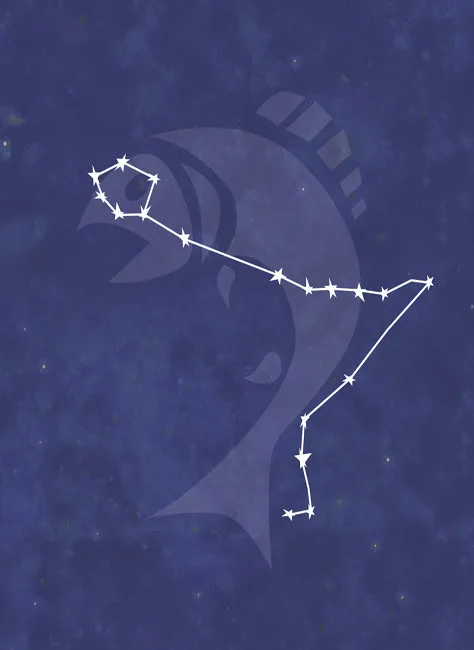
To escape and find safety, they transformed themselves into two fish and plunged into the river's depths. But fearing to lose each other in the flight, they tied themselves together with a silk cord — a ribbon connecting their tails. It is this bond that is reflected in the sky: the two fish of the constellation are always linked by a cord, one turned toward the north, the other toward the celestial equator.
Zeus immortalized this metamorphosis by placing the two linked fish among the stars, in memory of the solidarity between mother and son, of love as a bond that cannot be severed even by the absolute terror of the primordial monster.
Aquatic Symbolism & Duality
Pisces is the last sign of the zodiac — twelfth and final, it represents the dissolution of all forms, the return to the origin, the primordial water before creation. In Greek philosophy, water is the first element conceived by the pre-Socratics — Thales saw it as the principle of all things.
The two fish swimming in opposite directions but linked together symbolize the irreducible duality of the cosmos: past and future, conscious and unconscious, visible and invisible. The cord binding them is not a constraint — it is the invisible link that maintains unity within opposition, like Aphrodite and Eros, two distinct beings who cannot survive without each other.
In ancient astrological tradition, Poseidon governs Pisces — the master of the abyss, who reigns over all that is deep, hidden, mysterious. The sea is the mirror of the sky: what happens in the celestial heights finds its reflection in the marine depths.
The Constellation & the Vernal Point
The Pisces constellation is large and relatively dim — its stars are discreet, like the nature of aquatic depths. Its main star is Eta Piscium, a yellow giant, but it is Alrescha — "the knot" in Arabic — that marks the point where the two fish's cords join, a perfect symbol of the original bond.
The spring equinox has shifted from Aries to Pisces due to the precession of the equinoxes — a phenomenon of Earth's axis gyration over 26,000 years. Today, the vernal point — the moment when the Sun crosses the celestial equator in spring — lies in the constellation of Pisces.
The constellation also harbors a remarkable globular cluster, M74, a face-on spiral galaxy — like an eye gazing into infinity from the depths of the abyss constellation.
In Saint Seiya
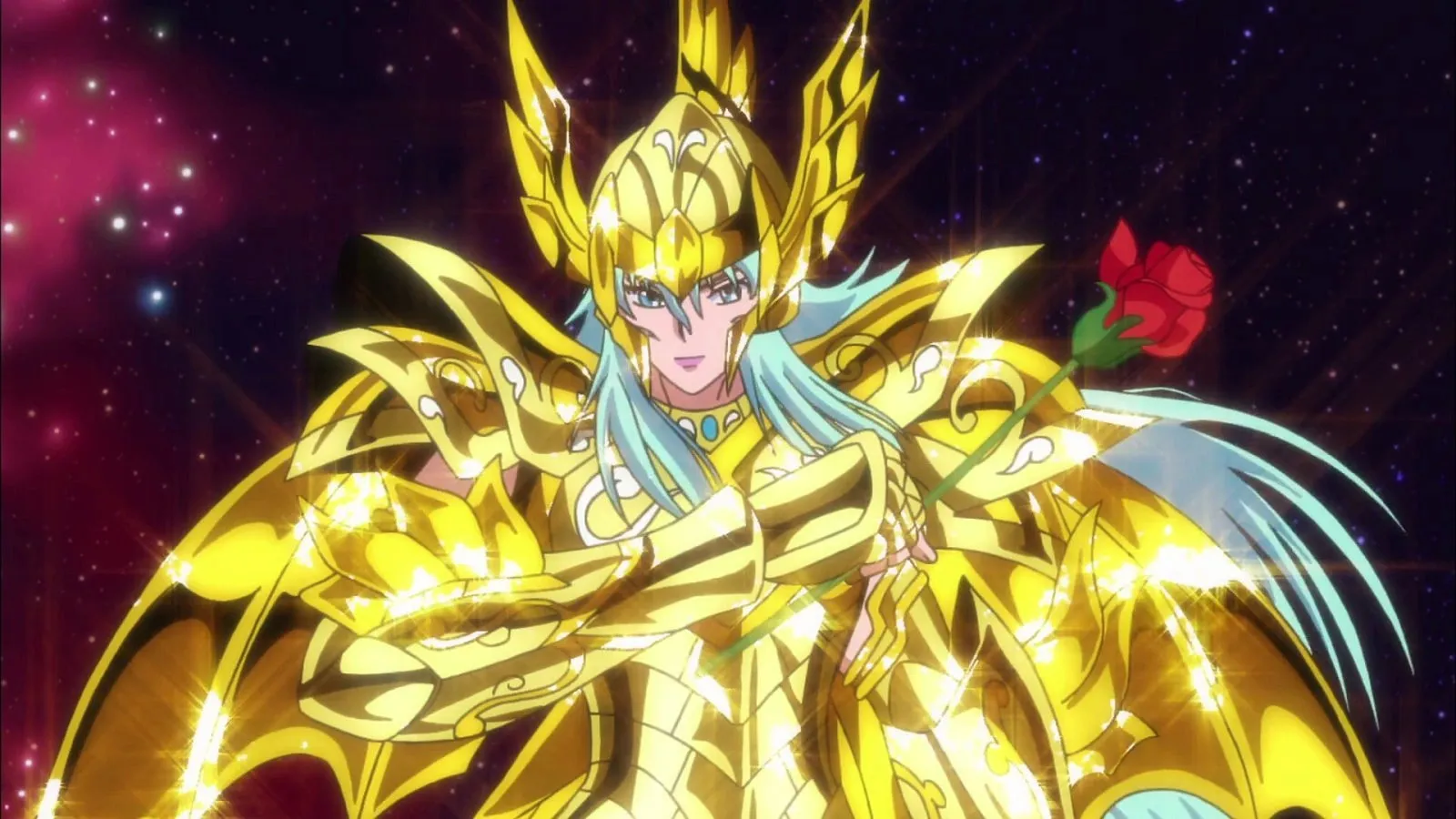
Gold Knight of PiscesThe Gold Knight of Pisces directly bears the name of the goddess Aphrodite whose metamorphosis into a fish is at the origin of the constellation. This choice by Kurumada explicitly links the character to the myth of the goddess: like Aphrodite transformed into a fish amid the waves, the Knight of Pisces uses roses — weapons of deadly beauty — whose venom dissolves his enemies as water erodes all things.
Aphrodite of Pisces's Piranha Roses and Bloody Rose are aquatic weapons in principle — they impregnate, penetrate, contaminate as water seeps everywhere. The twelfth House is the last, as Pisces is the last sign: to pass through this door is to have crossed everything, overcome everything.
The duality of the two linked fish is also reflected in the character's fundamental ambiguity: absolute beauty harboring merciless cruelty, in the image of Aphrodite herself — goddess of love who triggered the Trojan War.
Attributes
See also