Hades
God of the UnderworldOlympusGreek mythology · Sovereign of Tartarus · Judge of the Dead & Master of Shadows
Origins & Division of the World
Hades is the eldest son of Cronus and Rhea. Like his siblings, he was swallowed at birth by Cronus, who feared being overthrown by his offspring. Freed through Zeus's cunning, he took part in the Titanomachy — the great war between gods and Titans — alongside his brothers. After their victory, the three sons of Cronus drew lots for dominion over the universe: Zeus received the sky, Poseidon the seas, and Hades the vast underworld. This division was not a punishment but an equitable sharing of cosmic spheres.
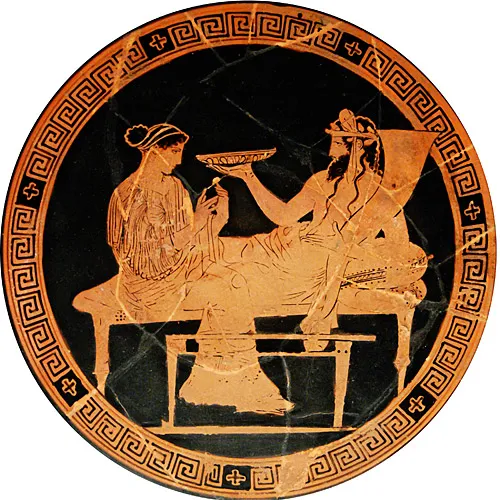
Hades reigns over the realm of the dead from his dark palace, alongside his wife Persephone. Contrary to the image of an evil god often associated with his name, Hades in ancient texts is a just and implacable deity — not cruel, but inflexible. He receives all souls without distinction, the rich and poor, heroes and cowards alike. His kingdom is neutral: neither automatic punishment nor reward, but a dim existence in the asphodel meadows for most of the dead.
The Abduction of Persephone
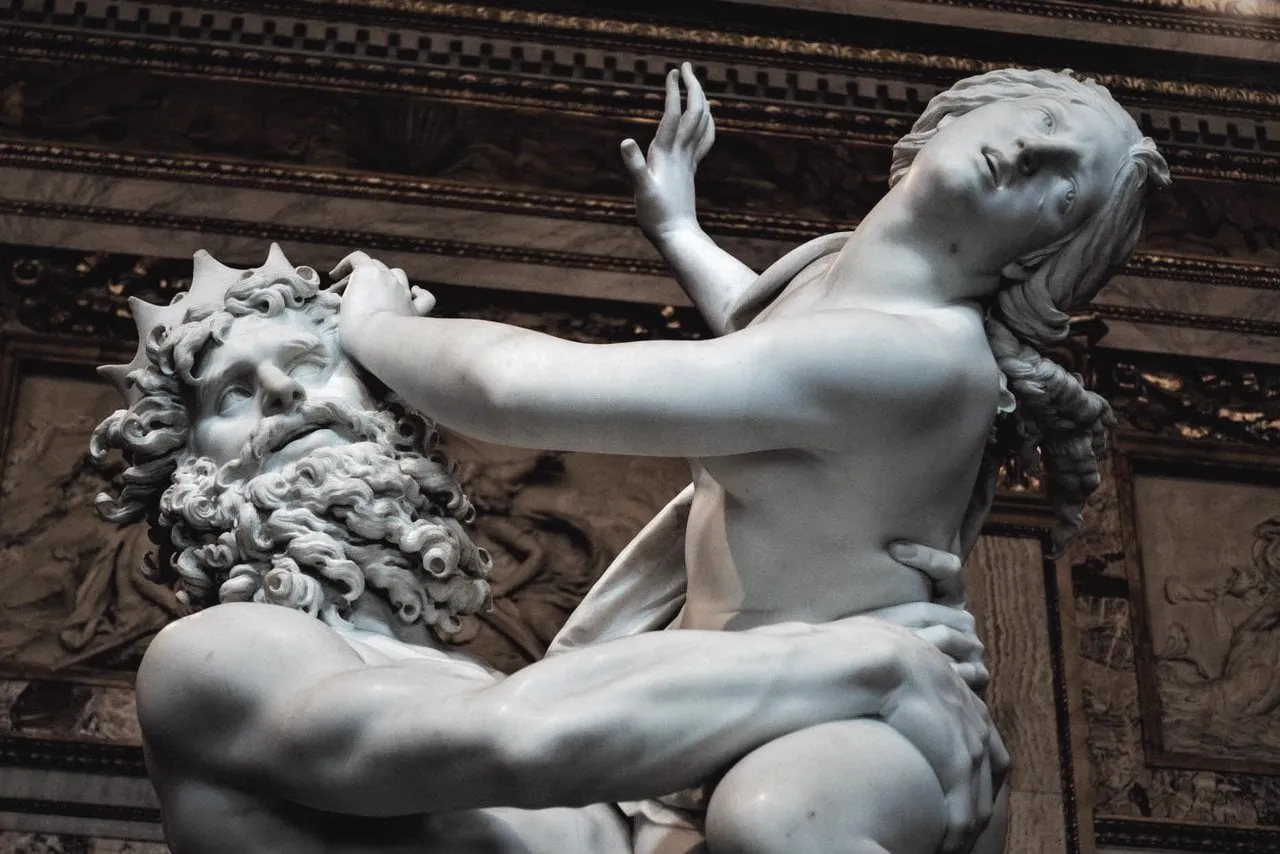
The most famous myth linked to Hades is the abduction of Persephone, daughter of Zeus and Demeter, goddess of the harvest. Enamored of the young goddess, Hades obtained Zeus's secret consent and seized her as she was picking flowers in a meadow in Sicily. The earth opened and the god of the Underworld carried her away in his black chariot. Demeter, desperate, abandoned her divine duties: the earth became barren, crops perished, and humanity faced famine.
Hermes was sent to the Underworld to negotiate Persephone's return. Hades consented, but had earlier offered the young goddess a few pomegranate seeds — symbol of marriage and the Underworld — which she had eaten. This bound her partially to the underworld kingdom. A compromise was reached: Persephone would spend part of each year in the Underworld with Hades, and the rest with her mother on Earth. This myth explains the cycle of seasons: winter and autumn correspond to Demeter's grief, spring and summer to her joy at reuniting with her daughter.
The Realm of the Dead
Hades's kingdom is a precise geography in Greek mythology. The souls of the dead cross the river Styx — river of the Oath — ferried by Charon, the boatman of the Underworld, provided they carry an obol placed under their tongue or on their eyes at burial. Without this coin, souls wandered for a hundred years on the bank. At the entrance, Cerberus — the three-headed dog — prevents the living from entering and the dead from leaving.
The souls are judged by three judges: Minos, Aeacus, and Rhadamanthus. Virtuous souls went to the Elysian Fields — a luminous paradise. Exceptional heroes accessed the Islands of the Blessed. Criminals were punished in Tartarus — the abyss where Sisyphus rolls his boulder, Tantalus suffers eternal torment, and Ixion spins on his wheel of fire. Hades himself possessed a helmet of invisibility, forged by the Cyclopes — the same gift they gave Zeus (the thunderbolt) and Poseidon (the trident).
In Saint Seiya
Underworld SagaIn Saint Seiya, Hades is the main antagonist of the Underworld Saga — the final arc of the original series. He reincarnates in the body of a young man and raises an army of Spectres — his warriors — to invade Athena's Sanctuary and destroy humanity. This ultimate confrontation between the god of the dead and the goddess who protects life faithfully echoes the mythological tension between Hades and Athena, representatives of two irreconcilable cosmic powers.
Kurumada draws directly from the geography of the ancient Underworld: the Tartarus prison, the infernal rivers, the Elysian Fields. The Bronze Saints must traverse these circles to reach Hades's palace — a descent into the Underworld that recalls the heroic katabases of mythology: Heracles chaining Cerberus, Orpheus seeking Eurydice, Aeneas visiting his father. The Underworld Saga is thus one of the most faithful modern adaptations of the ancient Greek afterlife.
Attributes
Rivers of the Underworld