Capricorn
Zodiac ConstellationOlympusGreek mythology · Pan & Amalthea · Metamorphosis & Abundance
Pan & the Flight from Typhon
The creation of Capricorn is linked to one of the most dramatic episodes in Olympian mythology: the war against Typhon — the ultimate monster, child of Gaia and Tartarus, whose hundred serpent heads breathed flames. Faced with him, even the Olympian gods took flight.
During the rout in Egypt, Pan — god of shepherds, forests and wild nature — plunged into the Nile to transform and flee. In his panic, the transformation was not uniform: his lower half became a fish, but his upper half remained that of a goat. Born of this clumsy hybrid form, the Capricorn — the sea-goat — entered mythology.
Zeus, amused by this creature born of divine fear, placed Capricorn among the stars as a memento of this extraordinary episode in which even the gods knew terror and disordered metamorphosis.
Amalthea — Nurse of Zeus
A second tradition associates Capricorn with Amalthea, the divine goat who nursed the young Zeus in the cave of Mount Ida in Crete. To protect the child from his father Cronus — who devoured his offspring — Rhea had hidden him there, entrusting him to Amalthea's care.
One day, young Zeus, playing with the goat, accidentally broke one of her horns. Abashed, he filled it with flowers and fruit, promising Amalthea that it would pour forth in abundance whatever she desired. This horn became the Cornucopia — the Horn of Plenty — one of the most universal symbols of prosperity and generosity.
In gratitude to this divine nurse, Zeus placed her among the stars. The two myths converge: Pan's sea-goat and Amalthea's nurturing goat both have a broken horn, both served the gods at a crucial moment, and both deserve their place in the sky.
The Gate of Capricorn
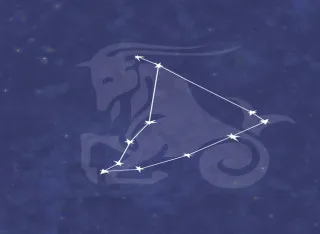
The constellation of Capricorn, discreet and triangular, is one of the oldest in the Babylonian zodiac. Just as Cancer marks the gate through which souls enter mortal bodies, Capricorn marks the Gate of Capricorn — the one through which souls ascend back to the gods after death, rejoining the divine from which they came.
This symbolism of passage and elevation is reinforced by the winter solstice: when the Sun enters Capricorn in December, the days begin to lengthen. It is the lowest point of the year, from which light is reborn — exactly like a soul that, having touched the depths of darkness, rises toward the divine light.
The principal star, Algedi (delta Capricorni), is in fact a double star visible to the naked eye. Dabih, the second bright star, is also multiple — complex systems that the Ancients perceived as a single light, symbol of the duality hidden within the apparent.
In Saint Seiya
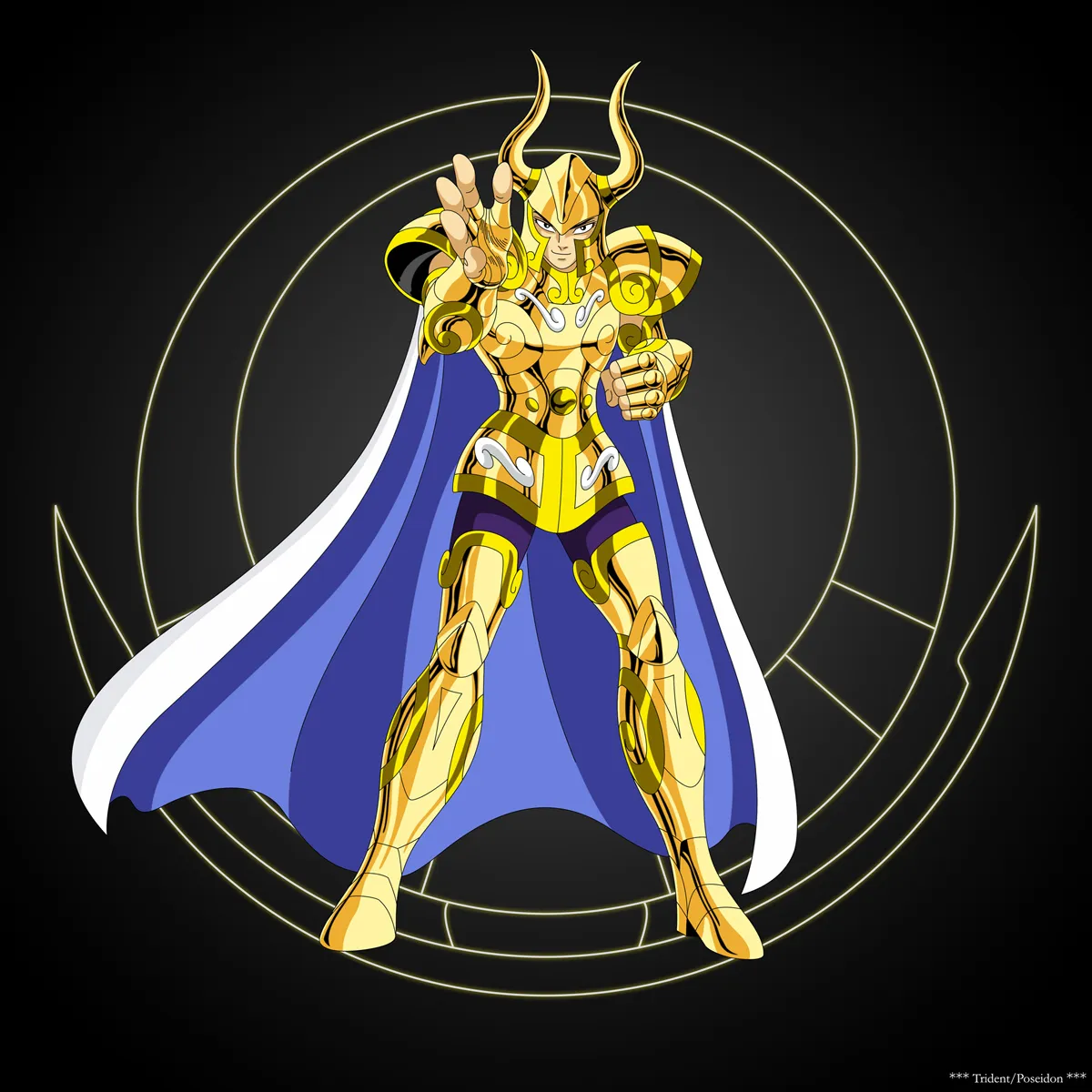
Gold Saint of CapricornShura of Capricorn is the knight whose technique — Excalibur — turns his arms into cutting blades capable of slicing through any material. This image of the absolute blade echoes the mythology: it was a broken horn that gave birth to the Cornucopia. The mythological Capricorn is the one who sacrifices — its broken horn becomes a universal gift.
Shura's Excalibur is precisely this divine attribute that transcends ordinary weapons: like Amalthea's horn that endlessly poured forth whatever was needed, Shura's technique is a blade that never dulls, infinitely sharp. It is not a material sword — it is crystallised cosmo, a divine weapon named after the legendary Arthurian sword to underline its absolute nature.
The symbolism of the Gate of Capricorn — passage toward divinity — also appears in the fact that Shura guards the tenth House, the penultimate step before Athena's sanctuary. It is the ultimate threshold before the ascent toward the divine, the last cutting obstacle separating mortals from the sacred.
Attributes
Associated Figures