Apollo
God of the SunOlympusGreek Mythology · Olympian Deity · Light, Arts & Prophecy
Origins & Birth
Apollo is the son of Zeus, king of Olympus, and the Titaness Leto. Hera's jealousy, Zeus's wife, condemned Leto to wander without finding shelter to give birth, as no land dared offer asylum for fear of divine retribution. It was finally on the floating island of Delos — a rootless land beyond Hera's jurisdiction — that Leto gave birth to twins: Artemis first, then Apollo, whose delayed birth lasted nine days and nine nights.
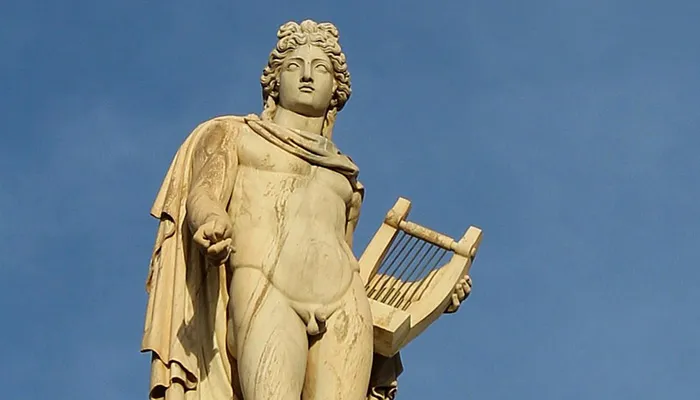
Barely born, Apollo claims his lyre, his bow and golden arrows. The gods of Olympus immediately recognize in him an exceptional deity. He leaves Delos on a chariot drawn by white swans and quickly wins the hearts of the Muses, becoming their leader — the Musagetes Apollo — guide of arts and sciences, whose patronage extends from music to medicine.
The Oracle of Delphi
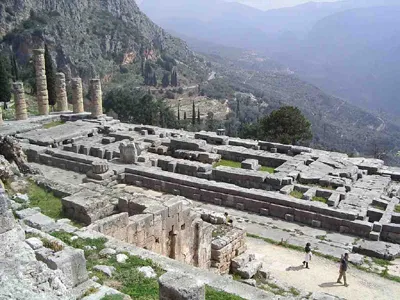
One of Apollo's founding acts is his victory over Python, the terrible serpent guardian of an ancient oracle nestled at the foot of Mount Parnassus. Python, son of Gaia, had persecuted Leto during her pregnancy. Apollo, to avenge his mother, confronted the monster and killed it with his silver arrows. On the site of this symbolic victory — triumph of light over darkness — he founded the famous sanctuary of Delphi, which would become the most venerated oracle of Antiquity.
The Pythia, Apollo's priestess, delivered her oracles from an underground cavity where intoxicating vapors rose. Entering a trance, she became the channel through which the god conveyed his responses to mortals — kings, generals and ordinary citizens — who came to consult the future. Her prophecies, often ambiguous and enigmatic, shaped the fate of entire nations. Apollo then purified himself of Python's murder in the valley of Tempe, and the sacred road between Delphi and Thessaly long bore his name.
Tragic Loves & Exiles
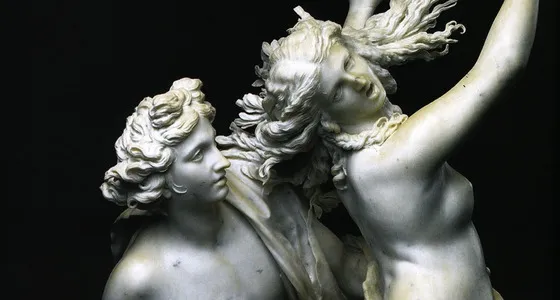
Despite his beauty and power, Apollo is cursed in love. The nymph Daphne, daughter of the river Peneus, spurns him desperately. Eros, mischievous, had shot Apollo with a golden arrow to inflame him with love, and Daphne with a lead arrow to inspire disgust. Cornered, the nymph prayed to her father to transform her, and was turned into a laurel tree just as Apollo was about to grasp her. Since then, Apollo adopted laurel leaves as his emblem — the laurel crown worn by victors still remembers this.
His pride also earns him two exiles from Olympus. The first time, he conspired with Hera and Poseidon against Zeus, and found himself condemned to build the walls of Troy as a servant of King Laomedon. The second time, he killed the Cyclopes to avenge his son Asclepius — god of Medicine — struck down by Zeus for having resurrected the dead. These episodes illustrate Apollo's duality: god of light, but also bearer of destruction and wrath.
In Saint Seiya
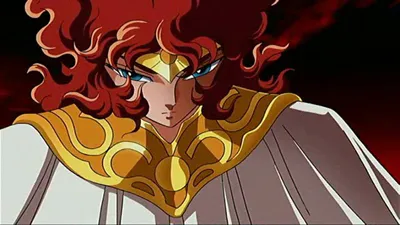
Film — The Heated Battle of the GodsIn the film Saint Seiya — The Heated Battle of the Gods (1987), Apollo appears as a divine antagonist. Accompanied by his sister Artemis, he descends to Earth determined to reclaim power over the world and eliminate Athena, whom he considers a usurper who betrayed her divine dignity by mingling with mortals. His luminous power is devastating, and the Bronze Knights must surpass their limits to face him.
This portrait faithfully draws from mythological sources: Apollo's arrogance, his sense of divine superiority, and his unbreakable bond with Artemis are all elements taken from ancient texts. Kurumada projects into this god of light the idea that the divine can become oppression when it refuses to acknowledge humanity. The Knights' victory — mere mortals — against an Olympian god recalls the heroic battles of Greek epics.
Attributes
Sacred Animals