Acropolis of Athens
Sacred SiteGreek MythologyGreek Mythology · Sanctuary of Athena · Sacred Hill of Athens
The Sanctuary of Athena
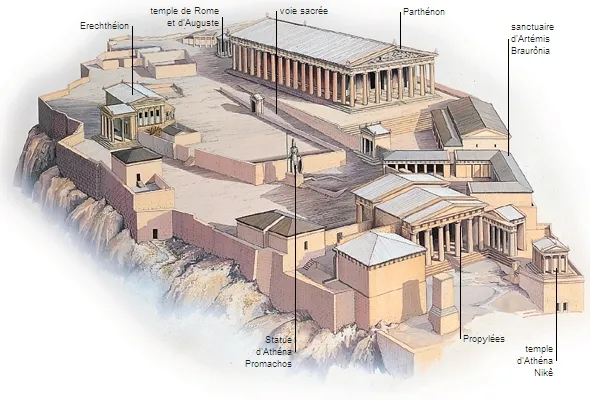
The Acropolis of Athens is a limestone rock that dominates the Attic plain at one hundred and fifty meters of altitude. Since Antiquity, this natural promontory has housed the most sacred temples of Greece: it is here that Athena, goddess of wisdom and patron of the city, reigns. It is accessed through the Propylaea — a monumental portico — before reaching the sacred terrace where the Parthenon, the Erechtheion, and the temple of Athena Nike stand.
The Parthenon, built between 447 and 432 BC under Pericles, was the jewel of the complex. Its sculpted friezes told of great mythological battles: the Amazonomachy to the west, the Gigantomachy to the east, the Centauromachy to the south, and the sack of Troy to the north — all stories in which Athena played a decisive role.
The Statue of Athena Parthenos
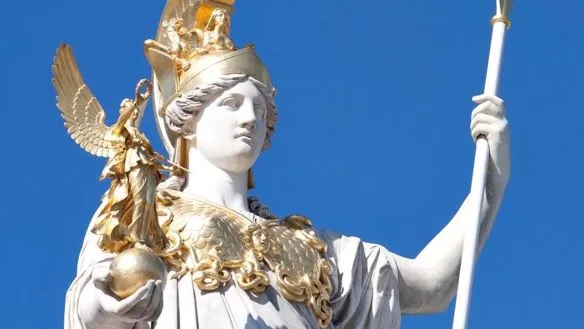
Inside the Parthenon stood one of the most celebrated works of Antiquity: the Athena Parthenos, sculpted by Phidias. Twelve meters tall, made of gold and ivory — a technique known as chryselephantine — she depicted the goddess standing, helmeted, holding a winged Victory in her right hand and her shield in her left. Her fame made her one of the wonders of the ancient world.
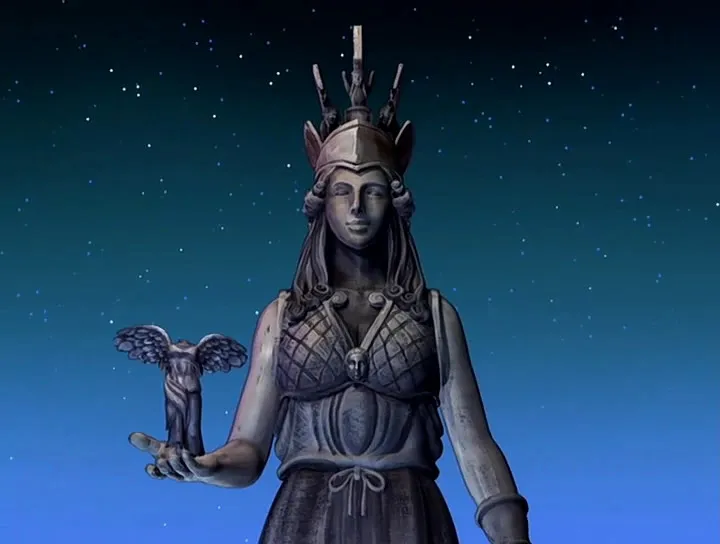
Another statue, the Athena Promachos, stood in the open air on the terrace. Facing the sea, she symbolically guided sailors who could see the gleam of her spear from the open water. This image — the statue facing the sea, sentinel of the world — would endure through the centuries.
The Temples & Mythology
The Acropolis is not dedicated solely to Athena: it concentrates several cults. The Erechtheion, with its famous Caryatids, houses the legendary tomb of Erechtheus, mythical king of Athens, and the sacred olive tree that Athena caused to spring from the ground during her dispute with Poseidon for sovereignty over the city. The two deities competed: Poseidon made a spring of salt water gush forth by striking the rock with his trident, but Athena offered the nourishing olive tree — and the Athenians sided with her.
The hill was also protected by ancient Cyclopean walls, a legacy of the Mycenaean era. The Greeks of the classical period considered this site inviolable, an intermediate space between the world of men and that of the Olympian gods.
In Saint Seiya
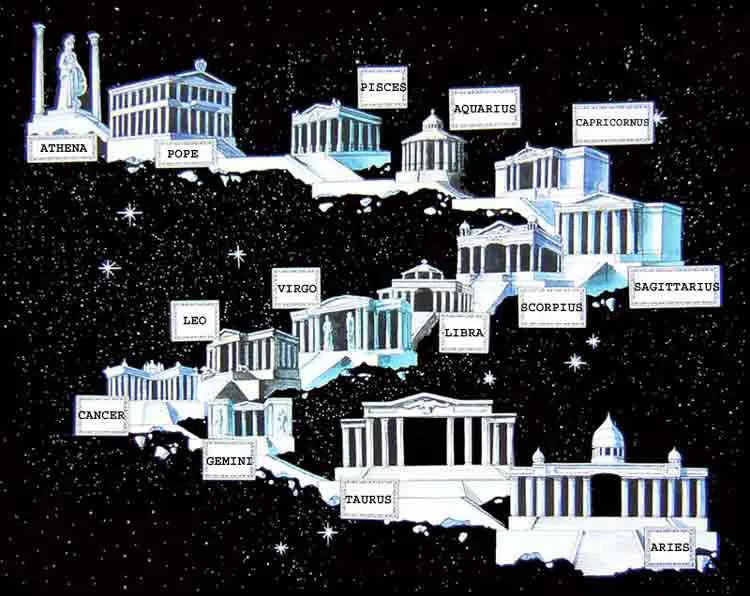
The SanctuaryThe Saints' Sanctuary in Saint Seiya is directly inspired by the Acropolis. Like it, it stands atop a hill overlooking the Aegean Sea. It is reached by climbing a long staircase leading to the Twelve Zodiac Houses — arranged along the path to the supreme temple, just as the temples of the Acropolis mark the ascent to the Parthenon.
The temple of Athena at the summit of the Sanctuary evokes the Parthenon, and the statue of the goddess — facing the sea, clad in her golden armor — recalls the Athena Promachos. Kurumada drew on the fundamental idea of the ancient site: a place consecrated to a single deity, grouping several sacred spaces, accessible only after an arduous ascent.
Attributes
Temples of the Acropolis